Last updated: June 12, 2026
Quick answerThe break-even between DTF and screen printing lands somewhere between 24 and 48 pieces. Under that number, DTF wins on price almost every time because there are no screens to burn and no setup fees to recover. At 100 pieces with a simple 1-2 color design, screen printing is usually cheaper per shirt. We run both methods in-house here in Meridian, so when a job comes in we quote whichever one actually makes sense for that order.
Around Meridian Dairy Days every June, we get a wave of last-minute shirt orders — youth sports booster clubs, church groups, small construction crews who all need 12 to 18 shirts by the weekend. That's when this question comes up constantly: DTF or screen printing, and which one won't kill the budget? The answer depends almost entirely on quantity and color count, so I'll lay out the actual numbers from our shop, plus the cases where one method clearly beats the other regardless of price.
What each method actually is
Last updated: September 21, 2026
Screen printing has been the go-to t-shirt decoration method for about 70 years. An artist creates a stencil for each ink color, burns those stencils onto mesh screens, loads the screens onto a rotary press, and pushes ink through each one onto the garment in sequence. The shirt then runs through a heat-curing tunnel to lock the ink into the fabric. It's a proven process. The catch is that every color costs money to set up before you print shirt one.
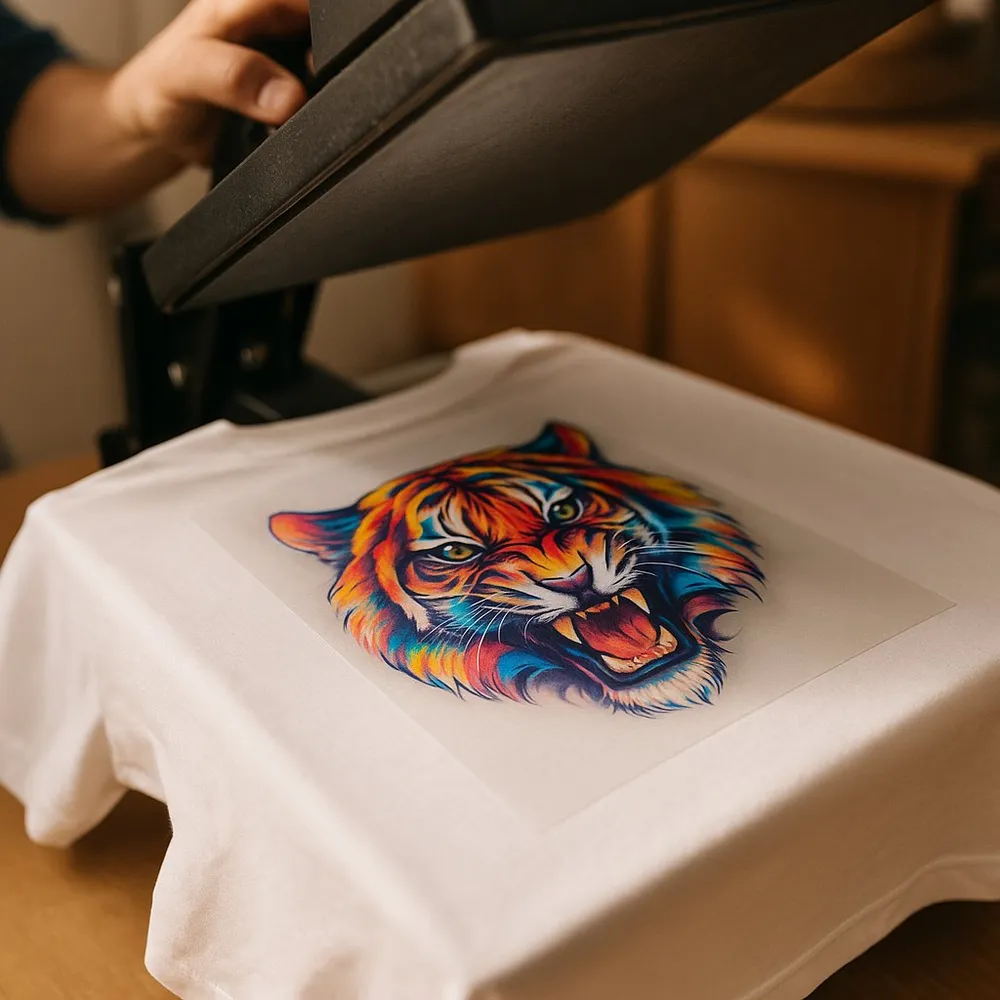
DTF (direct-to-film) printing became mainstream around 2026. The artwork is printed onto a transparent PET film with a white underbase already baked in. The film gets coated with adhesive powder, cured, then heat-pressed onto the garment in one step. Full color, no screens, no minimum. The trade-off is a slightly firmer hand-feel compared to a screen print, because the ink sits on the fabric rather than soaking into it.
Quality side-by-side
| Factor | Screen Printing | DTF |
|---|---|---|
| Color range | Limited to # of screens (usually 1-6 colors) | Unlimited full-color (photographic OK) |
| Detail / fine lines | Very good but mesh-limited | Excellent — handles 1pt text |
| Hand-feel | Slightly softer (ink soaks into fabric) | Slightly stiffer (ink sits on fabric) |
| Wash durability | 50+ wash cycles before crack | 50+ wash cycles before crack |
| Color brightness on dark garments | Needs white underbase + extra screens | Built-in white underbase, always bright |
| Setup cost per design | $20–$40 per ink color | $0 |
| Minimum order quantity | Typically 12-24 for cost-effectiveness | No minimum |
| Turnaround | 5-10 days (screens have to dry & cure) | Same-day possible |
| Fabric compatibility | Cotton, cotton-blend, some poly | Cotton, poly, blends, nylon, fleece — any fabric |
Where screen printing still wins
Screen printing earns its spot on very large, simple runs. If you're ordering 200 or more pieces of a 1-2 color design and you've got a couple weeks, the setup cost spreads thin enough that the per-shirt price drops below what DTF can match. That's the scenario where screen printing is clearly the right call.
It also wins on specialty inks. Puff, glitter, metallic foil, glow-in-the-dark, DTF can approximate some of those effects but not all of them. And if softness is the priority, a 1-color screen print on a quality blank is noticeably softer than DTF on the same shirt, because the ink actually soaks into the fibers instead of sitting on top. For athletic and performance fabrics where breathability matters, screen printing leaves most of the fabric uncoated, which preserves wicking better than a full-coverage DTF transfer.
Where DTF wins (most of the time)
Honestly, for most of the jobs we see walk through the door, DTF is the right answer. Small orders with no setup fees are the obvious case. A youth baseball team needs 14 shirts with a full-color logo by Thursday — that's DTF, no question. But there are a few other situations where it wins even when quantity isn't small.
- Full-color or photographic designs at any quantity under about 100 pieces. Adding a third, fourth, or fifth screen color costs $20–$40 each. DTF doesn't care how many colors are in the file.
- Rush turnaround. No screen-burn step means we can press same-day on in-stock items.
- Multiple garment types in one order. Print 30 transfers, press onto whatever mix of hoodies, tees, and quarter-zips you have. Screen printing locks you to one garment type per run.
- Variable names or numbers. Each shirt personalized differently carries zero additional setup cost per variation with DTF.
- Dark garments with bright colors. The white underbase is built in — no extra screen needed.
- Small replenishment orders. Need 6 more of last year's design? You'll pay no setup penalty at all.
The honest decision matrix
Most customers in the Treasure Valley fall into one of these buckets. The math behind these recommendations is the break-even on setup fees vs. per-piece savings at volume.
- Under 30 pieces, any design complexity: DTF wins on cost and speed.
- 30–100 pieces, 1-2 color design: Get quotes both ways. They'll be close enough that turnaround time might decide it.
- 30–100 pieces, full-color or photo design: DTF wins because each additional screen color adds $20–$40 in setup.
- 100–500 pieces, 1-2 color design: Screen printing typically wins per-shirt.
- 100–500 pieces, full-color design: DTF still often wins for the same reason — color count kills the screen print math.
- 500+ pieces, simple design, no rush: Screen printing's per-piece advantage compounds. This is its home turf.
- Rush at any quantity: DTF. Screens have to dry and cure; transfers don't.
How we quote both at our shop
We've been running both processes in-house for 7 years here in Meridian. When you send us a job, we quote whichever method is cheaper and still meets your deadline. We don't push you toward the one with better margin for us. If you come in with 250 pieces of a 1-color design and a 2-week window, we'll tell you screen printing is the right call. If you've got 18 pieces of a 4-color logo needed by Friday, we'll quote DTF and walk you through why.
That's harder to find than it should be. A shop that only runs one process is going to quote you that process regardless of fit. Running both means we can give you the actual right answer. (We've had customers come in who were quoted screen printing minimums elsewhere on a 10-shirt job — that's a real thing that happens.)
We hold a 4.9-star rating on Google across 48 reviews, and the one thing people mention most is that we tell them what makes sense for their order, not what's easiest for us.
Ready to get a quote?
Send us your spec: quantity, design, garment type, and deadline. We'll quote both methods if the order is close to break-even and tell you which one we recommend. Call or text us at .
Frequently asked
At what quantity does screen printing become cheaper than DTF?
Screen printing typically beats DTF on per-shirt cost somewhere between 24 and 48 pieces, once the setup and screen fees are spread across enough units. Under that, DTF has no setup charge and usually wins on total price.
Does DTF printing hold up as well as screen printing after washing?
DTF transfers are heat-bonded to the fabric and hold up well through repeated washes when applied correctly. The limiting factor is usually how the garment is cared for, not the print itself. Screen printing ink that's been properly cured is slightly more breathable, but both methods are durable for everyday apparel use.
Can Eagle Ridge in Meridian do small DTF orders with no minimum?
Yes. We print DTF with no minimum order, so a single shirt or a one-off piece is a completely normal job for us. Reach out, or request a free quote online — most small DTF orders on in-stock items can turn around same day.
Ready to start your order?
Send us your idea — we'll come back with mockups, pricing, and a real turnaround date within 24 hours.
Get a Quote contact usHow We Make This Stuff
Everything covered in this post is produced in our Meridian, Idaho shop at 2700 E Lanark St. Eagle Ridge Apparel is a family-run print shop serving the Treasure Valley since 2019 — we embroider, screen print, DTF, sublimate, laser-cut leather patches, laser-engrave drinkware, and UV-print promotional goods on equipment we operate ourselves. No outsourced decoration, no overseas fulfillment, no third-party middlemen.
Most custom apparel orders ship in 7–10 business days from approved mockup. Rush production in 3–5 business days is available on most decoration methods; embroidered hats are the tightest constraint. We hold no minimums on any decoration type — order one piece or one thousand — though pricing scales aggressively over 50, 100, and 250-piece tiers. Free digital mockups before production starts. We don't begin a run until you sign off on what it'll look like.
Two ways to order: design it yourself online in our designer tool (any quantity, any decoration method), or request a custom quote and we'll send back pricing within one business day. Talk to a real person — email info@eagleridgeapparel.com or send us a message, and most inquiries get a response within two hours during the business day.